- World’s first humanoid robot half-marathon held in Beijing to test bipedal robots in real-world conditions.
- Around 20 robot teams from across China participated, showcasing autonomous and remote-controlled machines.
- Event underscores China’s push to lead in AI and robotics, reinforcing its role as a global tech innovator.
Beijing witnessed a technological milestone this weekend as humanoid robots joined thousands of human runners in a world-first half-marathon, marking a significant step in China’s pursuit of innovation. The 21-kilometre race, held in the capital’s E-Town district—known as a hub for advanced manufacturing—was designed to evaluate the capabilities of bipedal robots under real-world conditions.
Dozens of androids lined up at the starting point alongside cheering onlookers and curious participants. While the event had the energy of a typical race, the mechanical participants moved at a much slower pace. Some robots hesitated with cautious steps, while others stumbled, with one even toppling over and eventually regaining its footing—drawing applause from the crowd.
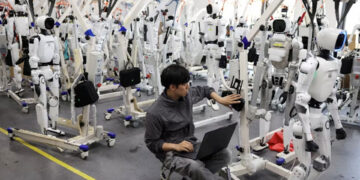
The marathon featured around 20 robotics teams from across China, fielding androids ranging in size from 75 to 180 centimeters and weighing up to 88 kilograms. Some machines ran independently using onboard programming, while others were guided remotely by human operators. The robots and human runners were kept on separate tracks to avoid collisions.

Rather than focusing on speed or competition, engineers aimed to evaluate the endurance, balance, and technical stability of the robots. Incidents such as veering off track or falling over offered valuable insights into how these machines might perform in unpredictable outdoor environments, far from the controlled settings of a laboratory.
This event reflects China’s broader ambition to become a leader in AI and robotics. With recent developments like cost-efficient AI chatbots and visually engaging humanoid robots featured in national broadcasts, the country continues to assert itself as a formidable player in the global tech landscape, challenging rivals like the United States in both innovation and execution.