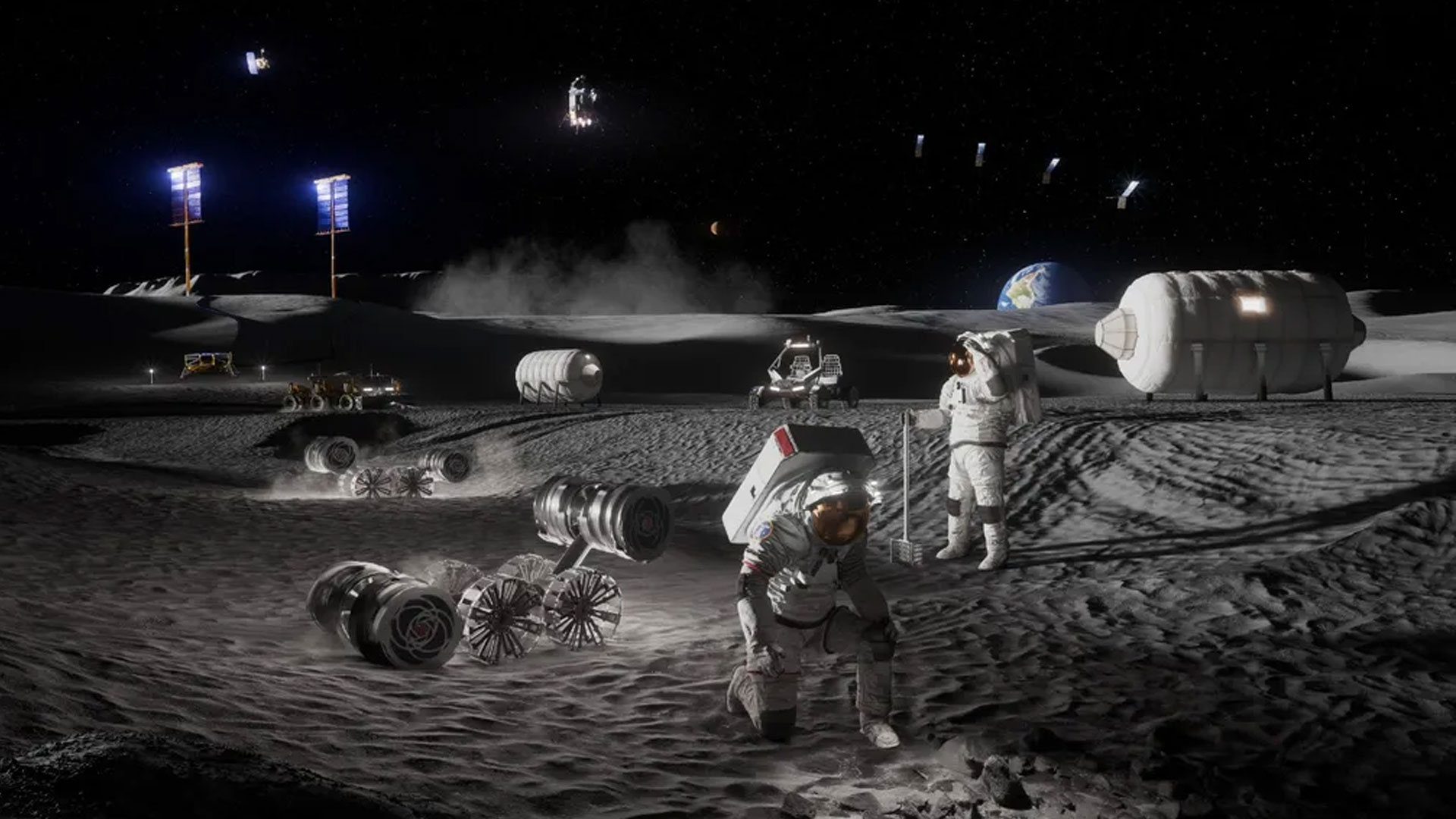
What happens when humanity decides to stop visiting space and starts moving in? The United States space agency unveiled a twenty billion dollar blueprint to construct a permanent city on the lunar surface. Targeted near the craters of the lunar South Pole, this metropolis will serve as a hub for technological research. Officials envision an outpost stretching across hundreds of square miles. The goal is to master off-world survival before expanding to Mars.
• Humanity is planning a permanent relocation to space.
• A twenty billion dollar lunar city is planned.
• The settlement aims to prepare humans for Mars.
Laying the foundation for this real estate requires immediate action. Three uncrewed missions are slated to launch later this year to deliver crucial hardware. The first payload will transport instruments designed to monitor thruster interactions with lunar dust. Following closely, the second mission will deploy rovers to navigate the treacherous terrain. A third operation will drop off cargo to test how materials endure extreme radiation.
• Three uncrewed supply runs will launch soon.
• Missions will deliver tracking instruments and rovers.
• Hardware will test material durability in space.
These supply drops represent the first phase of an ambitious timeline. The second phase is scheduled from 2029 to 2032 and focuses on transitioning to semi-permanent infrastructure. Once that foundation is secure, the third phase will commence to scale up operations for a fully sustained human presence. Planners intend for every mission to serve as a rigorous learning opportunity to refine construction techniques. Success is mandatory for future exploration.
• Current missions mark the first phase of colonization.
• Infrastructure is planned between 2029 and 2032.
• Sustained human presence is targeted after 2032.

Commercial aerospace companies are reaping financial rewards from this initiative. Blue Origin emerged as a primary beneficiary by securing massive contracts to provide heavy cargo landers. Other private enterprises have also been tapped to supply delivery vehicles. Reliance on corporate partnerships represents a major shift in how interplanetary logistics are managed. Outsourcing payload delivery allows scientists to focus on the research required to keep astronauts alive.
• Private firms are securing lucrative contracts.
• Blue Origin won funding for landing services.
• Commercial partnerships handle space logistics.
Skeptics are raising alarms over untested technologies and aggressive timelines. Several commercial partners have experienced recent failures in lunar delivery attempts or face delays with critical equipment. The shadow of an international space race adds intense political pressure to the project. China is rapidly hitting milestones with a roadmap to land astronauts on the moon by the end of the decade. Delays in the American program have experts wondering which nation will claim the high ground.
• Critics question the reliability of commercial partners.
• Equipment delays threaten the project timeline.
• A space race with China creates political pressure.
Via: Live Science