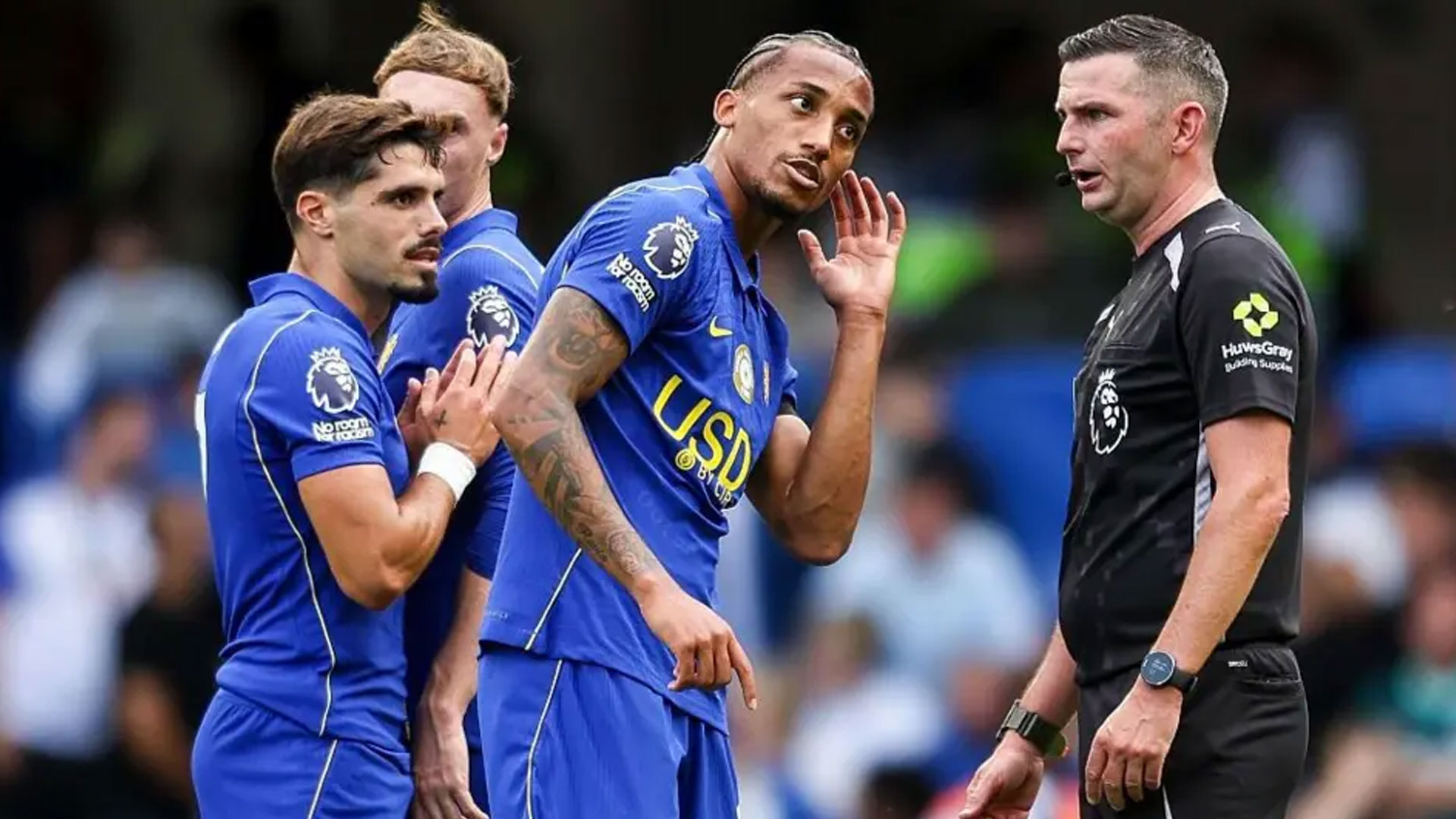
What happens when a Premier League referee suddenly loses the technology that keeps an entire officiating team connected? At Stamford Bridge, Michael Oliver and his colleagues found out during Chelsea’s dramatic 4-3 win over Brighton, when their communications system failed and left them working without radio contact for the entire second half.
Oliver returned from half-time without his communications pack, forcing him, assistants Stuart Burt and James Mainwaring, and fourth official Tom Bramall to abandon their usual radio system. The failure meant the officials could no longer communicate normally with one another, while the VAR team at Stockley Park was also cut off from direct communication with the referee.
• Premier League officials lost radio communication
• The problem lasted for the entire second half
• Oliver and his team had to operate without their usual headsets

The problem appeared to be linked to the system struggling to filter out the noise from Stamford Bridge. With thousands of supporters chanting, shouting and singing, conversations between officials became difficult to hear. Previous technical problems have caused brief delays while equipment was repaired, yet this time the system could not be recovered.
• Crowd noise disrupted the communication system
• Earlier failures had usually been fixed during matches
• Officials decided the equipment could not be salvaged
The failure created an even bigger question for VAR. How could Andrew Kitchen at Stockley Park communicate with Oliver when the normal radio link was unavailable? A backup system allowed Kitchen to send messages directly to the referee’s watch, while he could still communicate with Bramall through radio equipment.
• VAR communication with the referee was severely restricted
• Kitchen used messages sent to Oliver’s watch
• Bramall remained a communication link to the VAR team
Radio communication has been part of top-level English refereeing for decades. Officials were first equipped with microphones and earpieces during the 1999-2000 season, before more advanced radio technology became established from the 2006-07 campaign. The Stamford Bridge failure marked a rare return to a simpler era, leaving one of football’s most technologically advanced officiating systems relying on backup methods.
• Refereeing communication technology dates back to 1999
• Advanced radio systems became standard from 2006-07
• A Premier League match was effectively officiated the old-fashioned way
Via: South Bank Centre