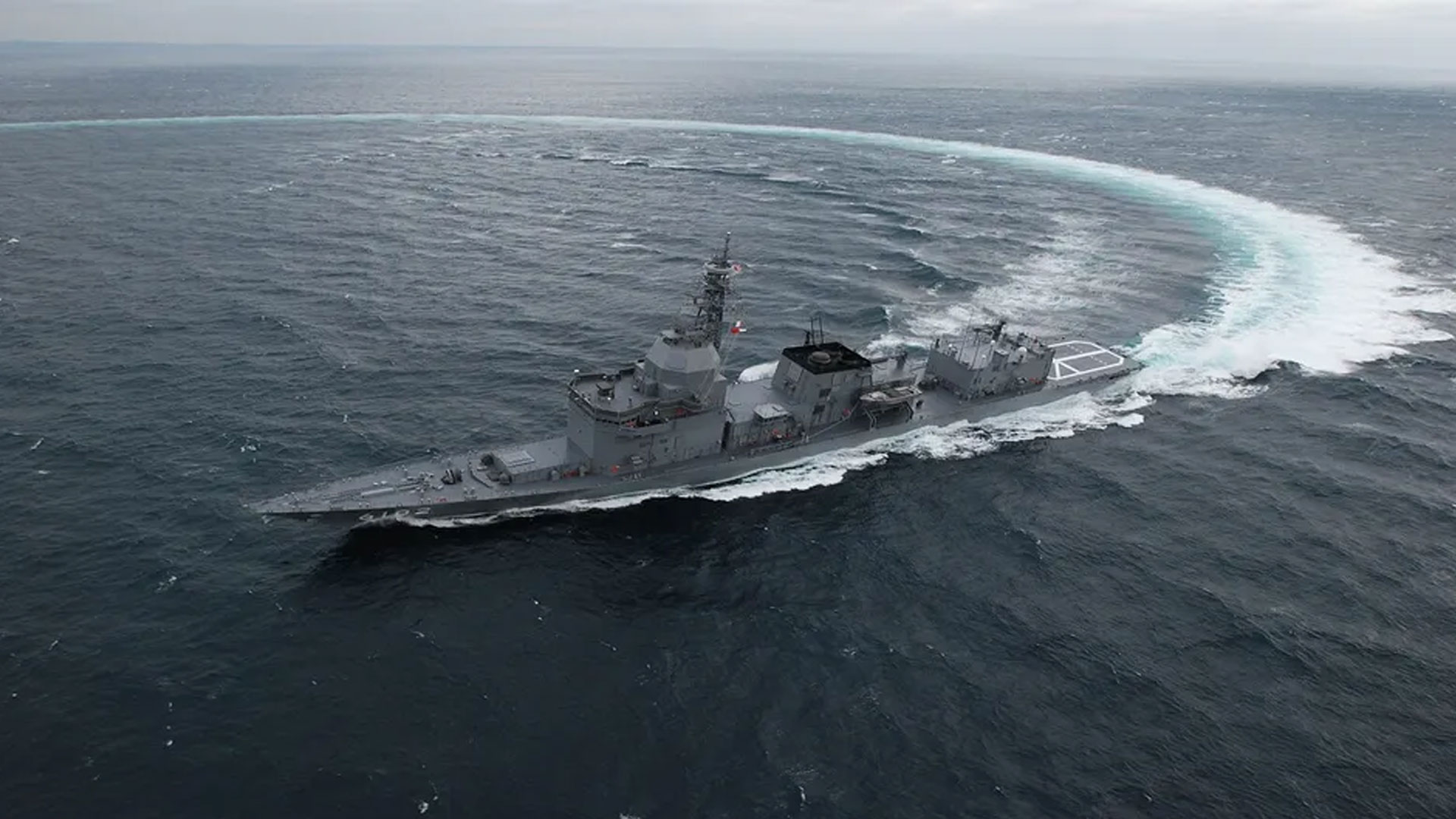
The future of naval warfare is arriving without the thunder of gunpowder, carried instead by silent beams of concentrated light. Japan has officially installed a 100-kilowatt laser system aboard the warship JS Asuka, a weapon capable of slicing through metal and disabling drones mid-flight. This high-tech array packs ten individual fiber lasers into two massive domed modules, focusing their combined energy into a single, devastating point designed to burn airborne threats out of the sky.
• Japan installed a 100kW laser on the JS Asuka.
• The weapon combines ten lasers into one beam.
• It is designed to disable drones and cut metal.
The core advantage of this directed-energy system lies in its theoretically bottomless magazine. Unlike traditional cannons that run dry, this weapon can fire indefinitely as long as the ship provides power, offering a cost-per-shot ratio that makes conventional air defense look archaic. Developed by Kawasaki Heavy Industries since 2018, the system has already proven its lethality against mortar rounds and unmanned aerial vehicles in ground tests, but the open ocean presents a far more volatile challenge.

• The weapon offers unlimited shots if powered.
• It is cheaper to operate than traditional missiles.
• Ground tests against mortars were successful.
Engineers are now preparing to push the hardware to its breaking point in rough waters starting in early 2026. The upcoming sea trials will determine if the laser can maintain a pinpoint lock on a moving target while battling the chaos of a pitching deck and atmospheric scattering caused by sea spray. Success here is critical, as the Acquisition, Technology and Logistics Agency aims to validate whether this technology is robust enough to eventually handle faster, more dangerous missile threats.
• Sea trials will begin after February 2026.
• The system must handle rough ocean conditions.
• Future goals include intercepting missiles.
Despite the futuristic promise, the laws of physics impose strict limitations on how soon these beams will see actual combat. Directed-energy weapons are notoriously power-hungry and inefficient, often converting only a fraction of their input energy into a laser beam while generating massive amounts of waste heat that requires complex cooling systems. Integrating such demanding infrastructure onto a warship remains a significant engineering hurdle that keeps full operational deployment several years away.
• Lasers require immense electrical power.
• Cooling systems are needed for waste heat.
• Operational deployment is still years away.
Japan is not alone in this race to weaponize light, joining the United States, France, and the United Kingdom in developing next-generation directed-energy defenses. While Britain has already field-tested its DragonFire system and China is suspected of equipping amphibious docks with similar tech, Tokyo plans to eventually mount these lasers on advanced Aegis-equipped vessels. The current tests are just the opening moves in a long-term strategy that targets a fully operational service entry in the early 2030s.
• Japan joins a global race for laser weapons.
• China and the UK are testing similar tech.
• Full service entry is expected after 2032.