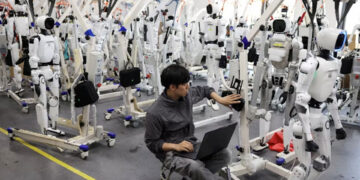
What if the next person working inside a massive data centre is not a person at all? Meta is reportedly testing robotic arms that can perform some of the repetitive jobs currently handled by human technicians, raising questions about how far automation could go inside the company’s rapidly expanding infrastructure.
• Meta is testing robots for data centre maintenance tasks.
• Some robots can physically interact with server hardware.
• The experiments could change how technicians work around data centers.
The experiments reportedly include robots that can power-cycle equipment and swap network cables. At Meta’s facilities in Iowa and Virginia, earlier robotic systems have already been deployed, while the Iowa campus has become a major testing ground for newer machines. Two-armed robots have reportedly been tested on cable-related work under human supervision.

• Robots are being tested on practical maintenance jobs.
• Iowa appears to be a key testing location.
• Human technicians are still supervising the machines.
Meta’s interest in robotic data centre workers is not entirely new. The company demonstrated a self-driving robot in 2023 capable of moving heavy server racks, showing how automation could tackle physically demanding infrastructure work. A simpler finger-like robot has now reportedly been used to press power buttons on hardware such as Mac minis.
• Meta has explored data centre robotics for several years.
• Earlier machines focused on moving heavy equipment.
• Newer robots are being tested on more precise physical tasks.
The challenge is that modern AI data centres are becoming increasingly complex. Robots need far more than strength to work safely around expensive hardware, with tasks such as connecting cables and reseating components requiring precision. Meta is also testing a scissor-lift-style machine equipped with a robotic arm at its Ohio campus, although worker feedback has reportedly included complaints about robots spending too much time recharging.
• AI infrastructure requires increasingly precise maintenance.
• Robotic arms are being tested on delicate hardware tasks.
• Battery life remains a practical obstacle.
The bigger question is whether these machines are designed to assist technicians or eventually replace much of their work. One employee reportedly estimated that robots could take over as much as 80% of human data centre workloads, although Meta has described robotics as a way to support incident response, environmental monitoring and preventative maintenance. For now, the machines remain under testing, leaving the future of the data centre workforce very much an open question.
• Automation could significantly reshape data centre jobs.
• Meta says robotics can support several operational tasks.
• The extent of future job replacement remains uncertain.
Via: Tech Radar