How much of a filmmaker’s life is actually spent creating art versus wrestling with the technical friction of a status bar? At the 2026 Sundance Film Festival, where the vast majority of premiering films rely on Adobe Creative Cloud, the answer to that question is shifting toward pure creativity. Adobe has unveiled a massive suite of updates for Premiere Pro and After Effects designed to eliminate the manual drudgery of post-production. The centerpiece is a new AI-powered Object Mask tool that allows editors to isolate complex moving subjects with a simple click. This shift signifies a move away from frame-by-frame adjustments toward an era of intelligent, intent-based editing.
• Adobe updates target the 85 percent of Sundance filmmakers using Creative Cloud.
• New AI Object Masking allows for instant isolation of moving subjects.
• The focus is on maintaining creative flow by reducing manual technical tasks.
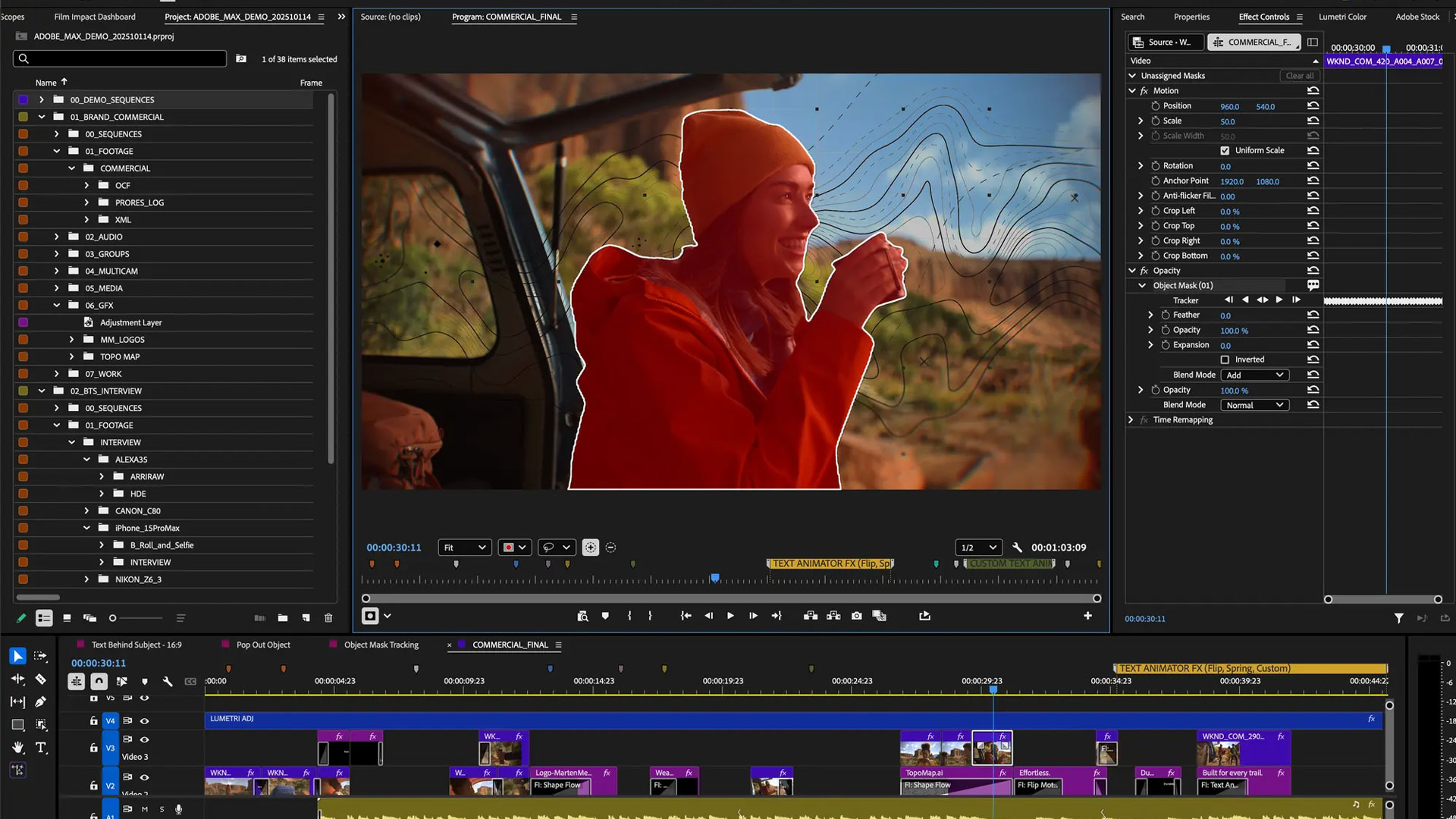
The days of meticulously drawing paths around a moving actor are effectively over thanks to on-device assistive AI models. This technology uses a hover-and-click interface to generate precise masks that track subjects across the frame automatically. Editors can now refine these selections using colored visual overlays and intuitive lasso tools to add or subtract specific areas. Because the AI remains entirely on-device, professional creators can work with the assurance that their private project data is never used for external model training. This balance of power and privacy ensures that high-end production standards meet modern efficiency.
• On-device AI enables instant masking without compromising user data privacy.
• Visual overlays and black-and-white alpha views provide clear mask previews.
• Refinement tools like feathering and expansion ensure professional-grade precision.
Speed is the defining characteristic of this update, particularly for the redesigned Shape Masks which now track up to 20 times faster than previous versions. These tools allow for rapid face blurring, scene relighting, and 3D perspective tracking that anchors effects to surfaces like walls or rotating screens. A new bi-directional tracking feature allows editors to find a perfect starting point and track both forward and backward simultaneously. This efficiency is paired with a live tracking preview, giving users the ability to spot errors in real time rather than waiting for a long process to finish. The result is a workflow that feels more like painting and less like data entry.
• Redesigned Shape Masks track up to 20 times faster for immediate results.
• 3D perspective tracking allows masks to stick to complex, rotating surfaces.
• Live tracking previews let editors identify and fix errors during the process.

Bridging the gap between the initial spark of an idea and the final cut is now easier with the integration of Firefly Boards. This AI-first collaborative space allows teams to generate storyboards and pitch assets that can be sent directly into a Premiere project with a single click. If a specific shot is missing during the edit, creators can generate placeholder b-roll or explore new visual concepts without ever leaving the timeline. This seamless loop extends to the new Frame.io V4 panel, which brings comments and versioning directly into the editing interface. Feedback from producers appears live on the timeline, ensuring that the distance between a note and a revision is as short as possible.
• Firefly Boards allow for real-time AI ideation and direct media import.
• Frame.io V4 integration keeps team feedback and versioning inside Premiere.
• Seamless asset generation helps fill gaps in footage during the post-production phase.
After Effects is also receiving its most significant upgrade in years, focusing on native 3D design and enhanced vector workflows. Motion designers can now create parametric 3D meshes like spheres and cones from scratch or apply over 1,300 free Substance 3D materials to add photorealistic depth. Typography reaches a new level of flexibility with Variable Font support, allowing designers to animate every axis of a font including weight and slant with precision. These improvements, combined with native WinARM support and faster preview playback, ensure that the software keeps pace with the demands of modern hardware. The barrier between a designer’s imagination and the final render is thinner than it has ever been.
• After Effects now supports native 3D parametric meshes and 1,300 materials.
• Variable Font support allows for deeply customized motion typography.
• High-performance playback and WinARM support optimize the software for new PCs.
Via: Adobe